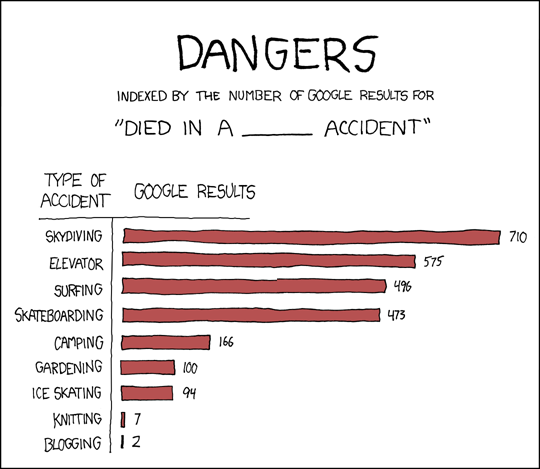
Just re-read a nearly 3-year-old xkcd:
And discovered that now the top Google result for "Died in a skydiving accident" is "Died in a blogging accident."
Wait what?
Monday, October 25, 2010
Friday, October 1, 2010
U.S. Government Seeks Backdoor into All Encrypted Services
U.S. Tries to Make It Easier to Wiretap the Internet
I really want to see the consensus on this story become, as loud as possible,
WTF is this, India?
Back in August we all* scoffed at this up-and-coming country reverting to its plebeian roots by demanding such a ghastly thing (if the image I'm painting isn't clear enough, let me add a swirling brandy snifter). But now we see our own government thinking India had a good idea with this. But if that brandy snifter-scoffing has any use, please let us use it to recognize how lowly we view this idea at least when put forward by someone else's government.
That's all for now. For further analysis, I'll defer to the EFF (usually a good idea):
Government Seeks Back Door Into All Our Communications
*Yes, be "we all" I mean only the perpetually-drunk-on-tech-news demographic. I'm sorry! It's hard to quit! It's a disease, you know.
Friday, July 16, 2010
Modern spam: I'm not even mad, Baxter. I'm honestly just impressed.
former comment on my post Desert Bus - Penn & Teller, Video Games, and Charity:
viagra online said...
I'm actually still not sure whether that was auto-generated or whether a human wrote that post. It seems at first that they actually have people looking at blog posts (at least cursorily) and writing comments relevant enough that before deleting them they require a discussion at the level of "Man, what even is spam?"
But my second thought was that hey, I have the terms "video games" and "charity" in my post, right in the title. So they could certainly have a general comment written for the topic of video game charities, then they search for relevant posts.
But then, how does "magic" get in there? I know they can easily relate the term "Penn & Teller" to "magic"; that's not the point. It's about why they insert "magic" into the comment. Is there a special variable in the "video games, [x] and charity" string? Would that even work enough to be practical? Almost seems more likely an actual human read the title of the post and made that comment.
The evolution of spam can get unexpectedly fascinating. It's almost biological in how it mutates in the face of evolutionary pressure from spam filters. It's gone to the extreme of irrelevance where you get an email that just talks about measuring the drapes on Thursday in order to not appear to your filter as spam, but its status as advertising is questionable. And now I see it's gone to an extreme of relevance where it blurs the lines between undesired spam and desired contribution.
viagra online said...
great idea combine video games, magic and charity, in this way is so easy show to rest of people how video games can help and not for destruction or violence.("viagra online" originally linked to a page on safemeds.com)
July 14, 2010 3:37 PM
I'm actually still not sure whether that was auto-generated or whether a human wrote that post. It seems at first that they actually have people looking at blog posts (at least cursorily) and writing comments relevant enough that before deleting them they require a discussion at the level of "Man, what even is spam?"
But my second thought was that hey, I have the terms "video games" and "charity" in my post, right in the title. So they could certainly have a general comment written for the topic of video game charities, then they search for relevant posts.
But then, how does "magic" get in there? I know they can easily relate the term "Penn & Teller" to "magic"; that's not the point. It's about why they insert "magic" into the comment. Is there a special variable in the "video games, [x] and charity" string? Would that even work enough to be practical? Almost seems more likely an actual human read the title of the post and made that comment.
The evolution of spam can get unexpectedly fascinating. It's almost biological in how it mutates in the face of evolutionary pressure from spam filters. It's gone to the extreme of irrelevance where you get an email that just talks about measuring the drapes on Thursday in order to not appear to your filter as spam, but its status as advertising is questionable. And now I see it's gone to an extreme of relevance where it blurs the lines between undesired spam and desired contribution.
Monday, July 12, 2010
Monday, June 28, 2010
Google suggests lulz
Some of these are really great. Also, it's a very easy meme to contribute to. See something funny when typing in searches? Screenshot! Honestly sometimes I'll intentionally type in the name of something to see what people are thinking about it. It's a pretty interesting tool in that way alone, really.
Unfortunately not an awesome Google Easter egg.
That's after typing only "i l"!
#2 ranking too!
Still don't know the explanation for this one.
Sort of reminiscent of recursion?
Even more after the jump!
Unfortunately not an awesome Google Easter egg.
That's after typing only "i l"!
#2 ranking too!
Still don't know the explanation for this one.
Sort of reminiscent of recursion?
Even more after the jump!
Friday, June 25, 2010
Dear Yellow Pages
We just got ours recently. Several huge books dropped off in front of a place exclusively inhabited by 20-somethings (maybe even an early-30-something), never to be touched again.
FYI, here's some ways to stop them delivering to your house.
(via fuckyeahdementia)
Monday, June 21, 2010
Wikileaker update - Hear Adrian Lamo talk about his decision to drop the dime
I've found two interviews with Adrian Lamo on his role in the arrest of Bradley Manning over the Collateral Murder video.
For me the biggest mystery in this whole thing is what motivated Adrian Lamo, the hacker, to turn someone in to the authorities. Lamo has spent so long on the other side of the coin and had his own troubles with the feds. Why did he decide to go out of his way to help them now?
People are putting forward a lot of different theories, and eventually you want to hear how Lamo himself would explain it. Well, here's a June 10th interview from an Australian podcast called Risky Business (it starts around 17:30). Then there's another at Salon.com where he's pressed a bit harder for his rationale, though the interviewer starts to sound (almost) as obtuse and closed-minded as a cable news talking-head. You can find it waaay at the bottom of this article, conducted by columnist Glenn Greenwald for background but also recorded and posted online.
Sunday, June 20, 2010
"can i forward a google voice number to another google voice number"
In trying to find the answer to the above question, I noticed 2 things. First, Google Suggest came up with that exact phrase as I typed my search terms, and second, there was no good answer when you searched it. I'm going to go ahead and assume others are looking for the same answer and also couldn't find it. So then I had to go with the empirical method and just try it myself.
And no. It won't let you.
Hopefully now people can find the answer ahead of time.
P.S. I then tried forwarding to the same number the other Google Voice number forwards to, and that doesn't work either. It'll let you go ahead and add the number, but then it kicks that number off your other account. Adding insult to injury, to get it back on your other account you have to re-claim it and set up voicemail forwarding all over again.
And no. It won't let you.
Hopefully now people can find the answer ahead of time.
P.S. I then tried forwarding to the same number the other Google Voice number forwards to, and that doesn't work either. It'll let you go ahead and add the number, but then it kicks that number off your other account. Adding insult to injury, to get it back on your other account you have to re-claim it and set up voicemail forwarding all over again.
Monday, June 14, 2010
Weird intrigue between Wired, Wikileaks, two ex-hackers, and the leaker of Collateral Murder
(This post presented in Bold Name-O-Vision to keep track of the Major Characters)
As someone who checks Wired News regularly and will click on any article about WikiLeaks [Wikipedia article here], in the last few weeks I've been treated to a fascinating drama that's developed because of the arrest of Army intelligence analyst Bradley Manning as the alleged source of the Collateral Murder video. This is the footage that came out this spring showing American Apache pilots in 2007 eagerly massacring a group of Iraqis including civilians and children.
The brief background is that Adrian Lamo, a famous ex-hacker, discovered during online chats with Manning that he leaked the classified footage to WikiLeaks. Lamo told the authorities and Manning was arrested. Now here's where it starts to get strange. Wired broke the news because Kevin Poulsen, another famous ex-hacker, is friends with Lamo and also now a writer for Wired. In fact he's been reporting on this story continually in Wired's Threat Level blog. Julian Assange, founder of WikiLeaks, is unsurprisingly unhappy about Lamo's outing of their source but is apparently angry at Poulsen too. He (or whoever tweets for WikiLeaks) has been leveling a twitter war against both of them, assuming they're in cahoots. Assange, who has assumed Manning's legal defense, even sent an email to Lamo requesting his chat logs and giving him some pretty derogatory "advice". And we know about the email because of Poulsen, who got it from Lamo and published it on Wired. Confused yet?
Something that makes this so weird is that each side in this seems complicit in at least some dirtiness. For instance I usually like WikiLeaks but Assange's email and tweets are such unmeasured, defamatory attacks that they betray a defensiveness that overrides his ideals. Then Lamo, of course, looks the villain by gaining the trust of, then outing a whistle-blower simply following his conscience. And Lamo's relationship with Poulsen hangs a doubt over the image of Poulsen simply reporting the events in objective journalistic fashion. The greatest example is Poulsen's acquisition of, then public posting of the email from Assange to Lamo. Even the organizations themselves seem a bit questionable in this whole exchange. It's not what I'm used to, having Wired take part in the drama instead of telling the story from a distance. As for WikiLeaks, I've already talked about their tweets.
In fact, the only one who seems to come out clean in this is Manning, who actually appears to have the purest intentions. Not all the facts are out yet but people are already mentioning him in the same breath as Daniel Ellsberg, a leaker from a previous disastrous war.
(credit: helpful background from this post on "TechEYE")
As someone who checks Wired News regularly and will click on any article about WikiLeaks [Wikipedia article here], in the last few weeks I've been treated to a fascinating drama that's developed because of the arrest of Army intelligence analyst Bradley Manning as the alleged source of the Collateral Murder video. This is the footage that came out this spring showing American Apache pilots in 2007 eagerly massacring a group of Iraqis including civilians and children.
The brief background is that Adrian Lamo, a famous ex-hacker, discovered during online chats with Manning that he leaked the classified footage to WikiLeaks. Lamo told the authorities and Manning was arrested. Now here's where it starts to get strange. Wired broke the news because Kevin Poulsen, another famous ex-hacker, is friends with Lamo and also now a writer for Wired. In fact he's been reporting on this story continually in Wired's Threat Level blog. Julian Assange, founder of WikiLeaks, is unsurprisingly unhappy about Lamo's outing of their source but is apparently angry at Poulsen too. He (or whoever tweets for WikiLeaks) has been leveling a twitter war against both of them, assuming they're in cahoots. Assange, who has assumed Manning's legal defense, even sent an email to Lamo requesting his chat logs and giving him some pretty derogatory "advice". And we know about the email because of Poulsen, who got it from Lamo and published it on Wired. Confused yet?
Something that makes this so weird is that each side in this seems complicit in at least some dirtiness. For instance I usually like WikiLeaks but Assange's email and tweets are such unmeasured, defamatory attacks that they betray a defensiveness that overrides his ideals. Then Lamo, of course, looks the villain by gaining the trust of, then outing a whistle-blower simply following his conscience. And Lamo's relationship with Poulsen hangs a doubt over the image of Poulsen simply reporting the events in objective journalistic fashion. The greatest example is Poulsen's acquisition of, then public posting of the email from Assange to Lamo. Even the organizations themselves seem a bit questionable in this whole exchange. It's not what I'm used to, having Wired take part in the drama instead of telling the story from a distance. As for WikiLeaks, I've already talked about their tweets.
In fact, the only one who seems to come out clean in this is Manning, who actually appears to have the purest intentions. Not all the facts are out yet but people are already mentioning him in the same breath as Daniel Ellsberg, a leaker from a previous disastrous war.
(credit: helpful background from this post on "TechEYE")
Saturday, June 12, 2010
Subscribe to:
Posts (Atom)